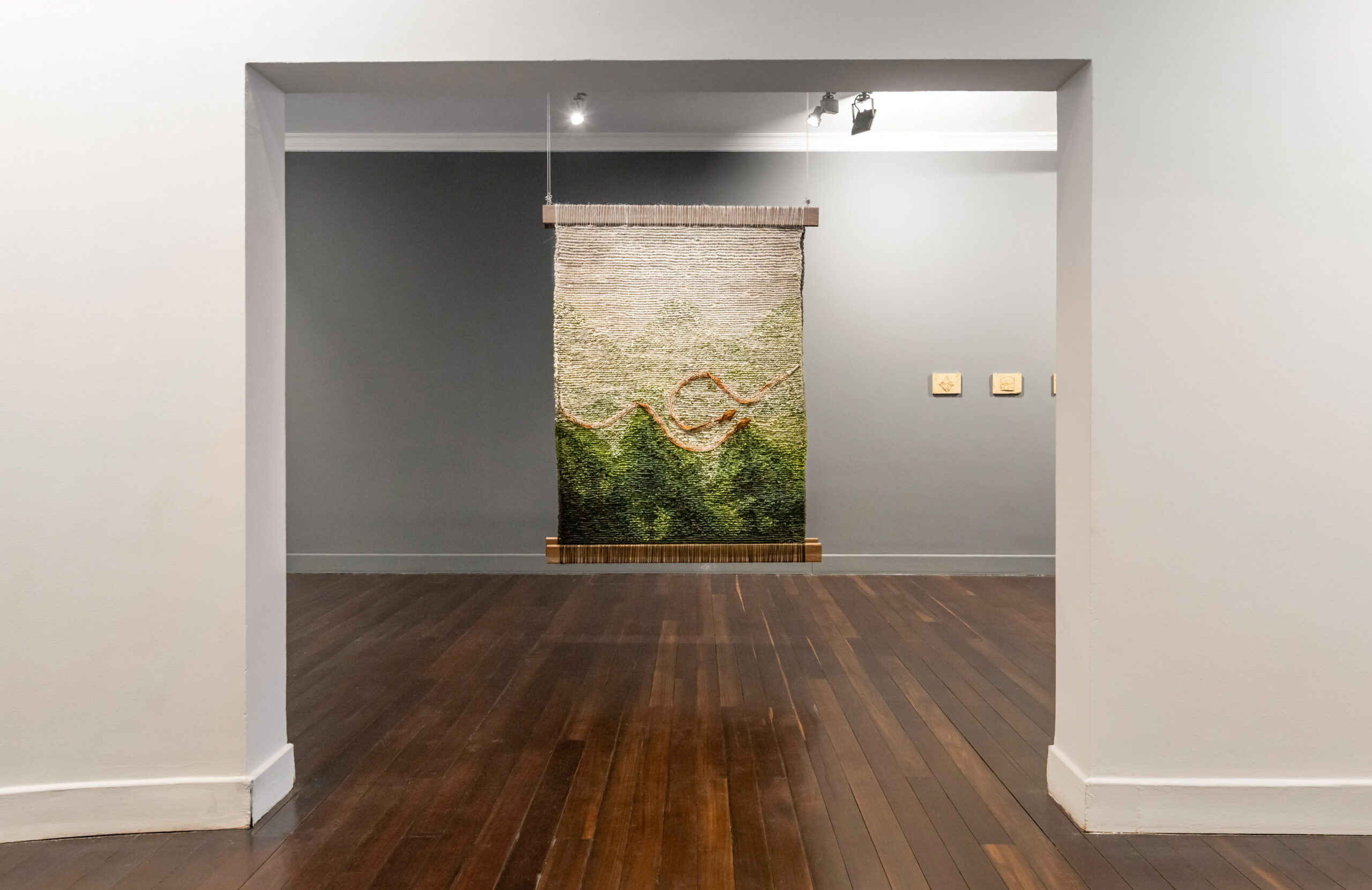
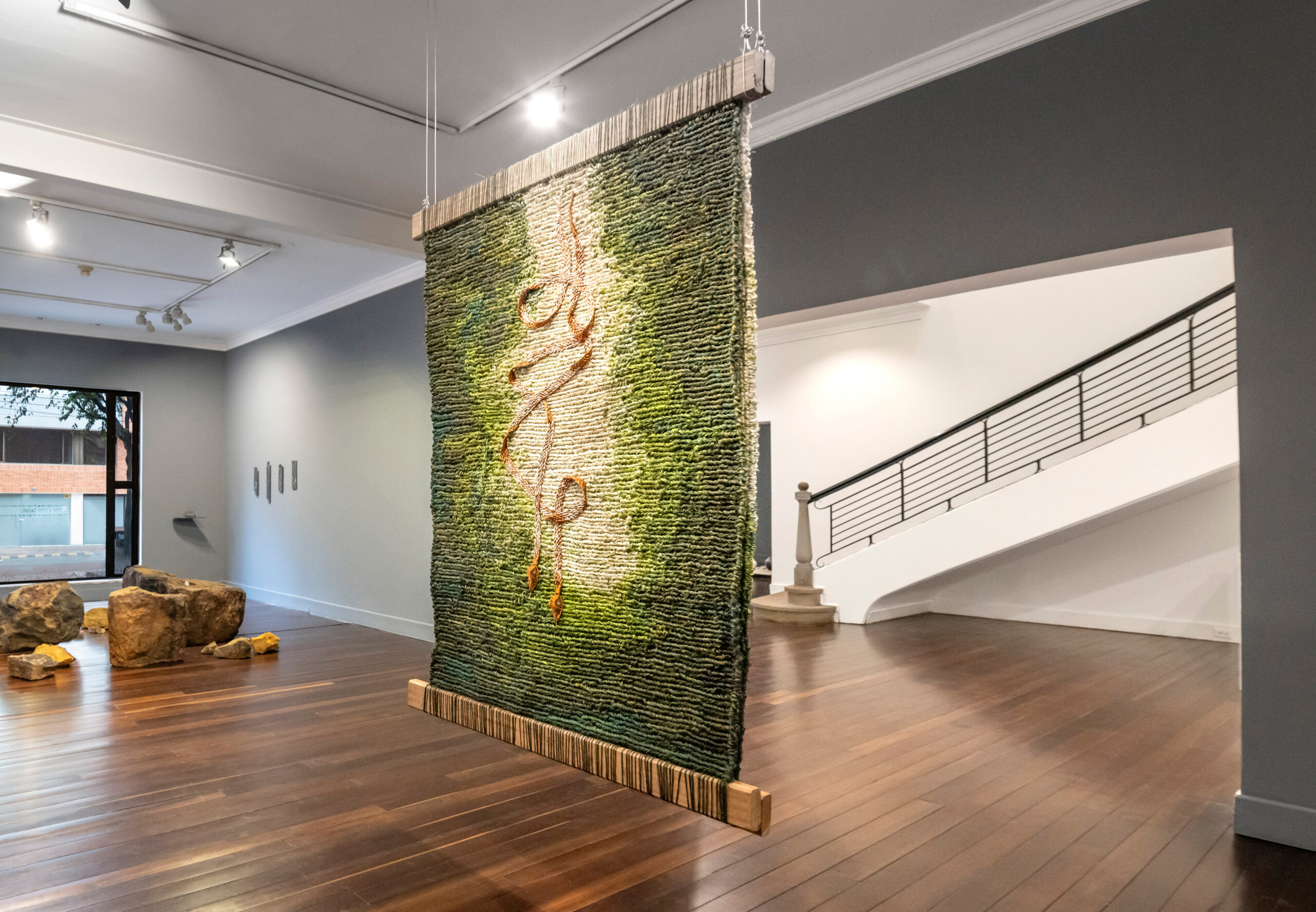
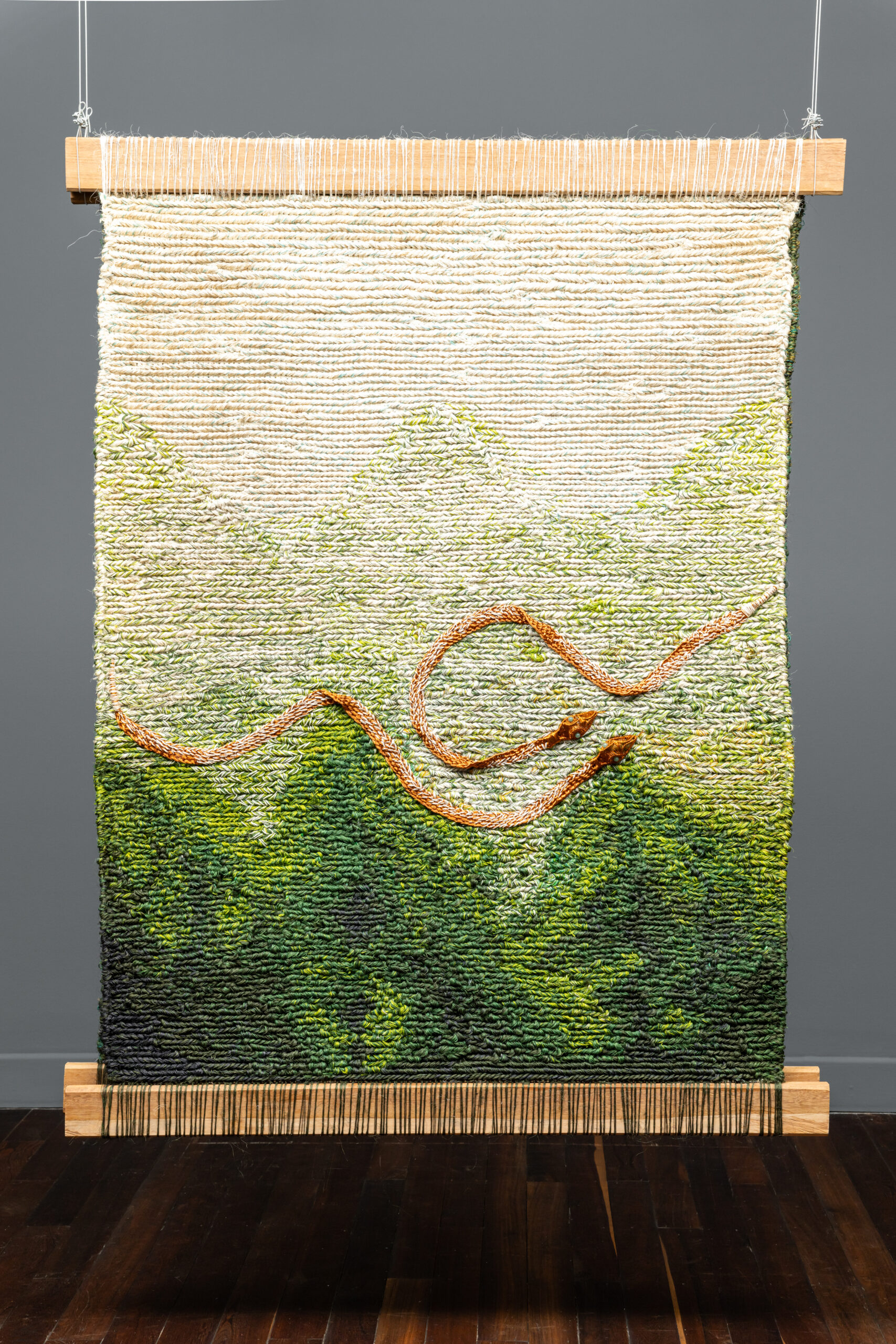
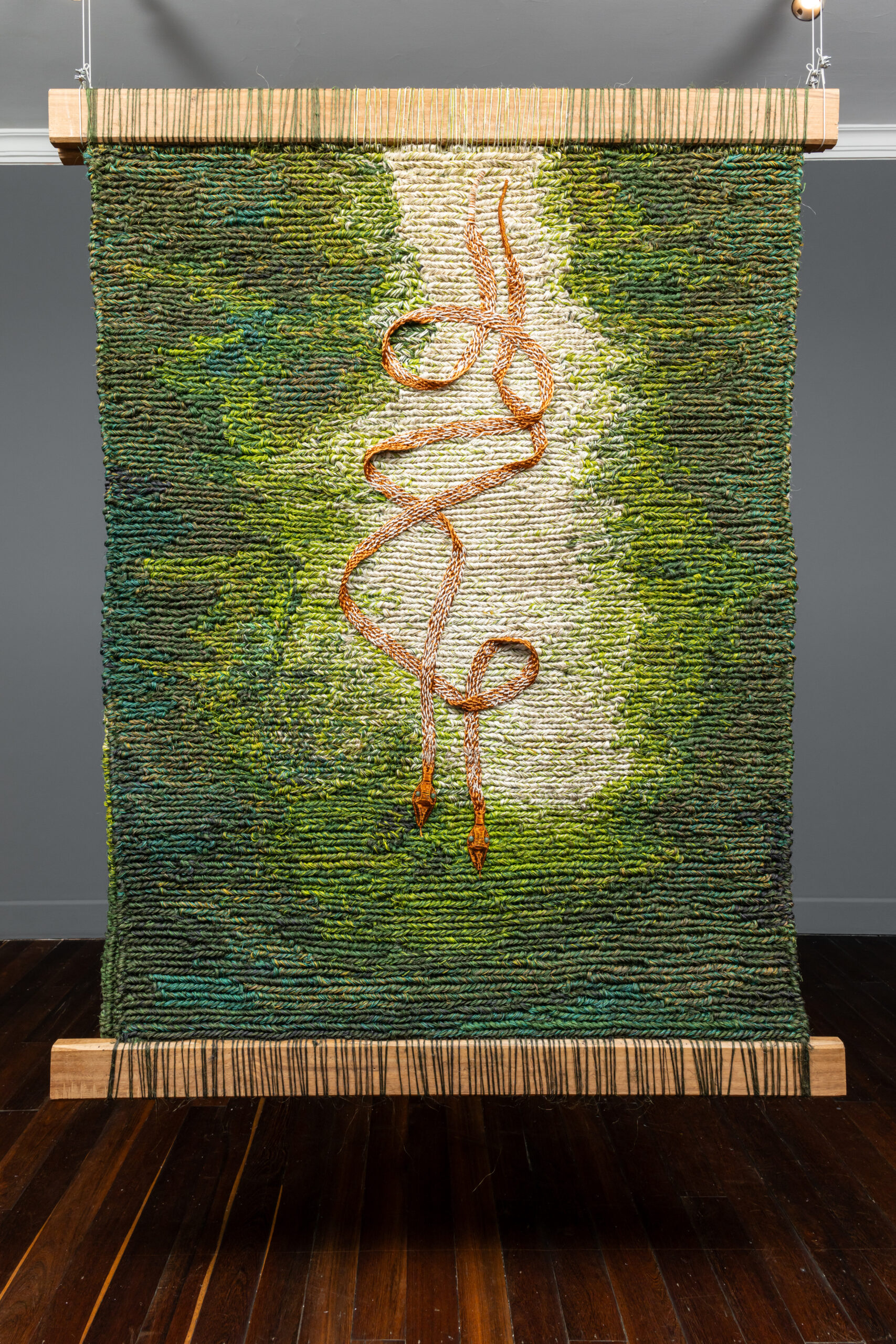
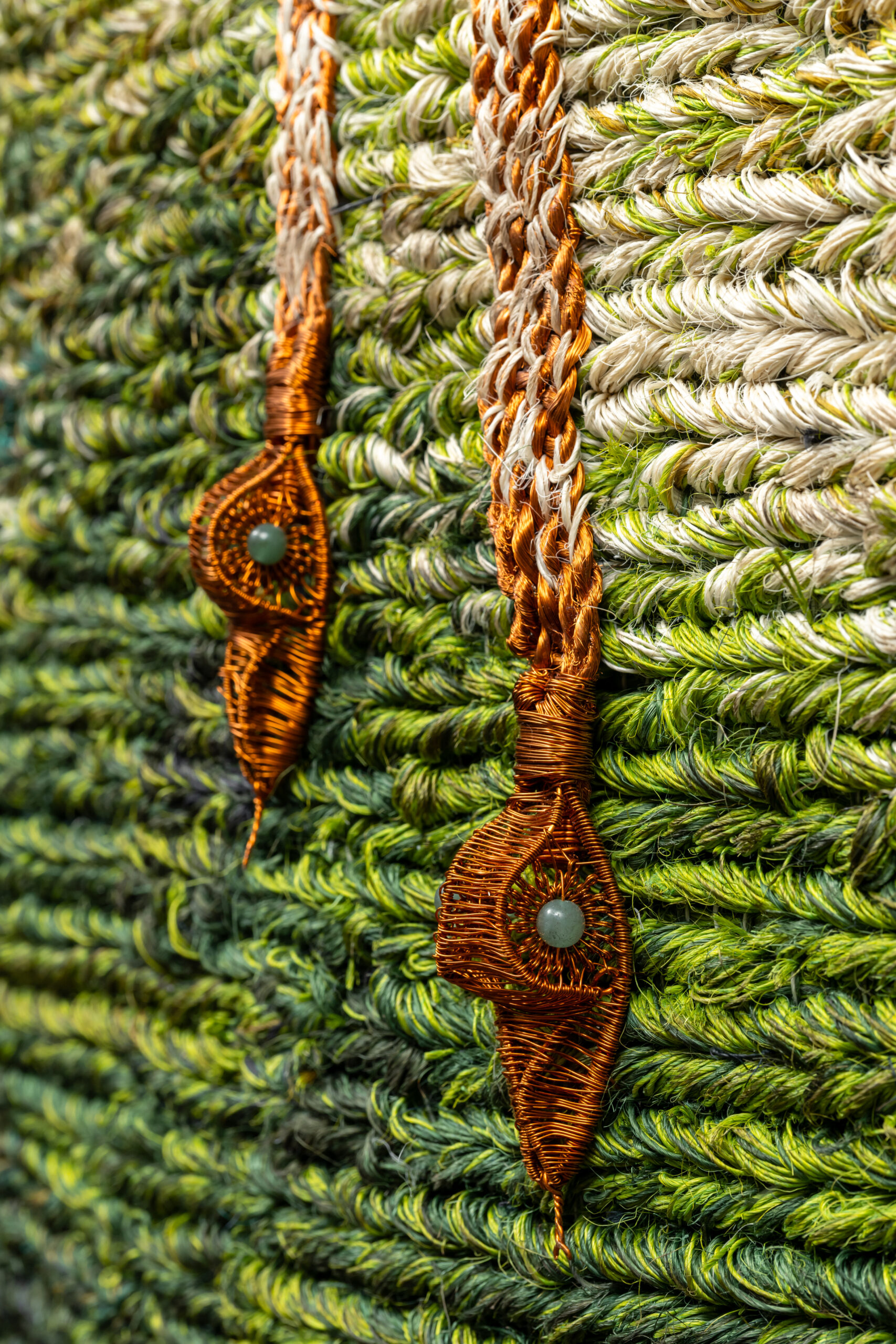
Laguna de Iguaque: interior y exterior, 2024. Dimensions: 193,5 x 135 x 5 cm. Vertical fabric in fique and copper thread supported by wood.
The work Laguna de Iguaque: Interior and Exterior draws on the foundational myth of Bachué, mother of the Mhuysqa people, and on the sacred lagoon of Iguaque, the site where this narrative is set. According to oral tradition, Bachué emerged from the waters of the lagoon at the dawn of time, later returning with her husband in old age to reenter its depths, both transformed into serpents. This myth articulates notions of fertility, community, temporality, and the cyclical relationship between humanity and nature.
The weaving is executed in fique and copper thread, materials chosen for their symbolic and material resonance. The lagoon is represented from dual perspectives: its external appearance—colors, vegetation, surrounding landscape, and the mist that envelops it—and its imagined interior, a space of myth and transformation. The mist, identified in Mhuysqa cosmology as the goddess Faoba, embodies a protective force guarding the lagoons against Spanish colonizers, who sought the gold deposited in their waters as offerings.
Within both compositions, two serpentine figures rendered in copper thread evoke Bachué and her husband, depicted at the moment of their return to the lagoon and their submersion into its depths. The work thus reinterprets a key episode of Mhuysqa mythology, situating it within a material and visual language that underscores the interplay between landscape, myth, and memory.
___
La obra Laguna de Iguaque: Interior y Exterior se inspira en el mito fundacional de Bachué, madre del pueblo Mhuysqa, y en la laguna sagrada de Iguaque, lugar donde se desarrolla esta narración. Según la tradición oral, Bachué emergió de las aguas de la laguna en los albores del tiempo, y más tarde regresó con su esposo en la vejez para volver a sumergirse en sus profundidades, ambos transformados en serpientes. Este mito articula nociones de fertilidad, comunidad, temporalidad y la relación cíclica entre la humanidad y la naturaleza.
El tejido está realizado en hilo de fique y cobre, materiales elegidos por su resonancia simbólica y material. La laguna se representa desde una doble perspectiva: su aspecto externo —colores, vegetación, paisaje circundante y la niebla que la envuelve— y su interior imaginario, un espacio de mito y transformación. La niebla, identificada en la cosmología mhuysqa como la diosa Faoba, encarna una fuerza protectora que custodia las lagunas contra los colonizadores españoles, que buscaban el oro depositado en sus aguas como ofrendas.
En ambas composiciones, dos figuras serpentinas representadas en hilo de cobre evocan a Bachué y a su esposo, representados en el momento de su regreso a la laguna y su inmersión en sus profundidades. La obra reinterpreta así un episodio clave de la mitología mhuysqa, situándolo dentro de un lenguaje material y visual que subraya la interacción entre el paisaje, el mito y la memoria.