Célula
2025
In the concept of the fractal, all the information of the cosmos is contained in the smallest part that composes it. A cell in its shape contains the spiral, which is where the universe begins and ends.
Como es arriba es abajo
2025
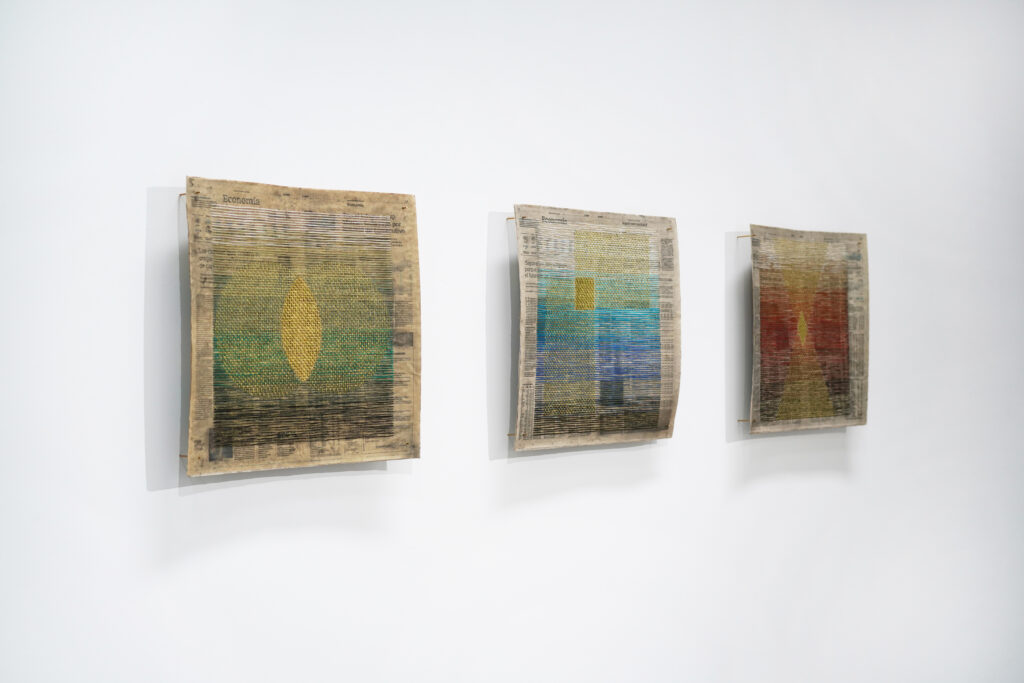
As above, so below is a Hermetic maxim that refers to the Principle of Correspondence, which states that there is a relationship and similarity between the different planes of existence
El inicio de la materia
2025
Break down the forms until reaching the most basic shapes, where everything begins and ends.
Profundidad-Superficie
2025
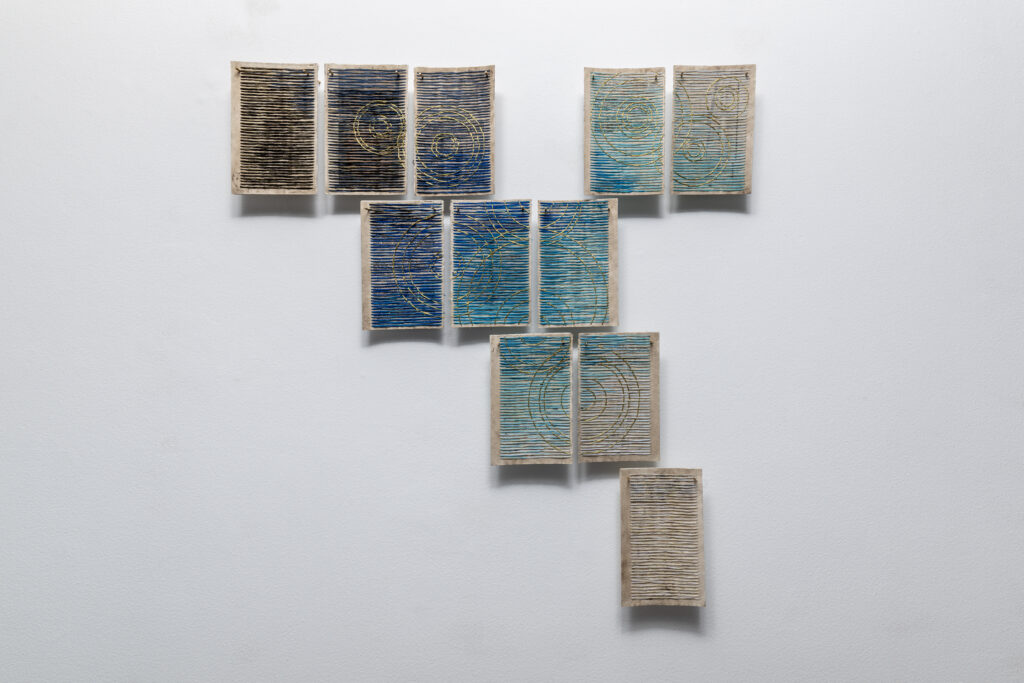
In Profundidad-Superficie, the artist works on forms that I observe being generated on the surface of water and in its depths.
Cantos
2025
Nothing is motionless, because everything moves and everything vibrates. The universe is vibration; the universe is sound.
Imaginando el misterio I
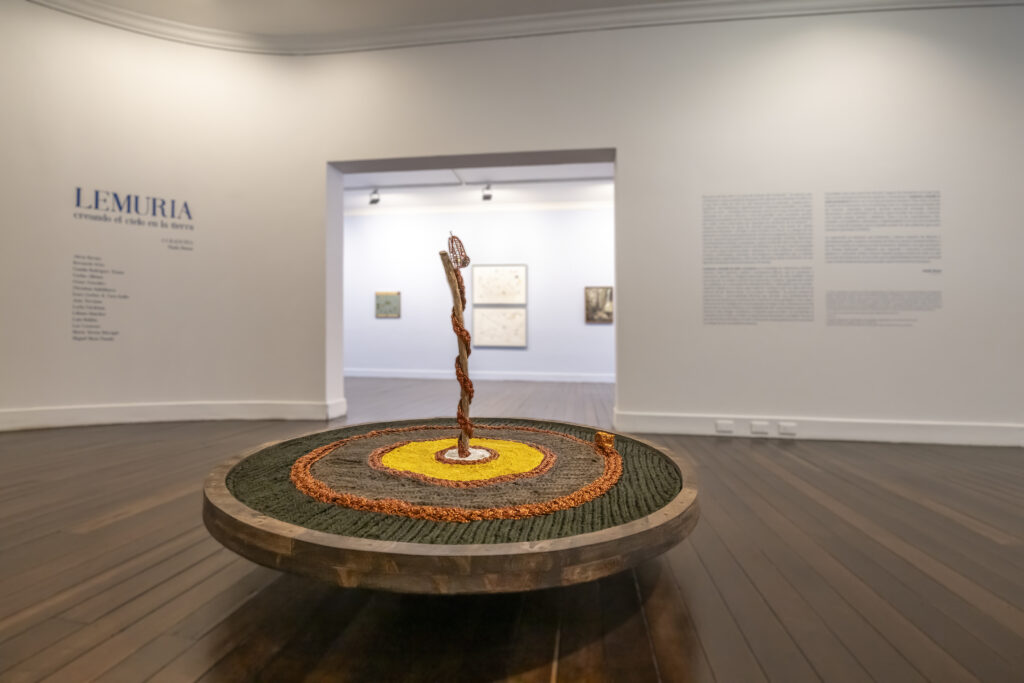
The Mhuysqa Indigenous people understood the world in a fractal way. For them, the territory was a fractal of the celestial geography, and our body was a fractal of the territory. The law of fractality describes objects that exhibit self-similarity—patterns that repeat themselves at different scales. If the universe is a fractal, then our smallest part—the cell—would contain all the information of the cosmos. Science has discovered that the law of fractality applies to many natural phenomena, such as trees, mountains, river systems, and more.
The universe reproduces itself systematically in a fractal form. For this to happen, a driving force is required: vibration. We call the oscillation between extremes vibration, and the rhythm of this oscillation frequency. Its most iconic image is the wave, which, when seen from another perspective, becomes a spiral or a vortex. But there are other fractal forms that appear throughout the universe: have we ever wondered what tree branches, the veins in our bodies, and lightning in the sky have in common? Or what sunflowers, snails, whirlpools, and our belly buttons share?
Fractals reproduce both internally and externally, because—as above, so below, and as below, so above—in the fractal world.
The reality we perceive comes to us through vibration. Our senses are instruments that detect different vibratory states at different frequencies, transmitting them to the brain, which then translates them into the reality we experience. Light, for example—the small portion of the electromagnetic spectrum that our eyes can detect—consists of electric and magnetic fields oscillating with each other. It is this vibration that our sense of sight perceives.
Sound, on the other hand, is a vibration in atmospheric pressure—an impression produced in the ear by waves that propagate through an elastic medium, such as air. What we hear is an illusion created by the brain from the vibrations impressed upon the ear.
In this way, we understand that our senses are limited, and that what we perceive as empty space is, in fact, filled with everything that escapes our senses and perception. Most of the universe is “empty.” It is estimated that only about 5% of it consists of visible matter. This apparent emptiness holds electromagnetic radiation, cosmic particles, neutrinos, dark matter, dark energy, vibrational waves of different frequencies, and a sparse presence of gas and dust.
When I imagine this mystery, I wonder about what my senses cannot perceive—about what inhabits the space we call “empty.” Through different methods, I try to draw what is invisible to my eyes. Sometimes I use digital programs to visualize sound waves or light vibrations. Other times I use fractal patterns found in the visible world to imagine what may exist in the invisible one, guided by the phrase “as above, so below.” Sometimes I turn to the simplest figures of the visible world: patterns formed in water by vibration, shapes created by the interplay of light and shadow, or forms observed in the cosmos.
This project is an attempt to see what our senses do not allow us to see—an always unsuccessful attempt to grasp the mystery. Yet the words “unsuccessful attempt” are not negative; they speak of accepting the human inability to contain the whole, despite our desire to do so. They speak of accepting that there will always be images, sounds, and knowledge that elude us, no matter how hard we try to capture them. That is where mystery resides—in the part of the world that vanishes the moment we think we have caught it, that slips away when we believe we understand it, in everything we cannot name.
___
Los indígenas Mhuysqas comprendían el mundo de manera fractal. Para ellos el territorio era un fractal de la geografía celeste y nuestro cuerpo era un fractal del territorio. La ley de la fractalidad describe objetos que exhiben autosimilitud, es decir, patrones que se repiten a diferentes escalas. Si el universo es un fractal, en nuestra parte mas pequeña -la celula- estaría contenida toda la información del cosmos. La ciencia ha descubierto que la ley de la fractalidad se aplica en muchos fenómenos naturales como árboles, montañas, sistemas fluviales, etc.
El universo se reproduce sistemáticamente de una forma fractal. Para que esto sea posible se necesita de una fuerza motriz: la vibración. Denominamos vibración a la oscilación entre los extremos y denominamos frecuencia al ritmo de esta oscilación. Su imagen mas significativa es la onda, que mirada desde otro punto de vista se vuelve una espiral o un vórtice. Pero existen otras figuras fractales que se reproducen en el universo: alguna vez nos hemos preguntado que tienen en común las ramas de los arboles, las venas de nuestro cuerpo, los relámpagos del cielo? O qué tienen en común los girasoles, los caracoles, los remolinos que se producen en el agua o nuestro ombligo?
Los fractales se reproducen en sentido interno y externo, porque como es arriba es abajo y como es abajo es arriba en el mundo fractal.
La realidad que nosotros percibimos es a través de la vibración. Nuestros sentidos son herramientas que captan distintos estados vibratorios a distintas frecuencias que luego son transmitidos al cerebro, el cual los traduce como la realidad que percibimos. La luz, por ejemplo, que capta nuestra vista es una pequeña porción de todo el espectro electromagnético. Los rayos de luz son campos eléctricos y magnéticos que oscilan entre sí, que están vibrando. Esa vibración es la que capta nuestro sentido de la vista.
El sonido, por su parte, es una vibración en la presión atmosférica. El sonido es una impresión producida en el oído por un conjunto de vibraciones que se propagan por un medio elástico como el aire de la atmósfera. Aquello que oyes es una ilusión generada por tu cerebro sobre las vibraciones impresas en tu oído.
De esta manera comprendemos que nuestros sentidos son limitados y que lo que percibimos como espacio vacío está lleno de todo lo que se le escapa a nuestros sentidos y percepción. La mayor parte del universo es vacío. Se estima que solo alrededor del 5% del universo esta compuesto por materia visible. El espacio vacío contiene radiación electromagnética, partículas cósmicas, neutrinos, materia oscura, energía oscura, ondas vibratorias a diferentes frecuencias, además de una muy baja densidad de gas y polvo.
En imaginando el misterio I me pregunto por aquello que mis sentidos no pueden percibir, por aquello que habita el espacio que llamamos espacio vacío. A través de diferentes métodos intento dibujar eso que es invisible para mis ojos. A veces utilizo programas digitales que dibujan las ondas sonoras o las vibraciones de la luz. Otras veces utilizo los patrones fractales que estàn en el mundo visible para imaginar aquello que habita el mundo que no podemos percibir, basándome en la frase de como es arriba es abajo. A veces recurro a las figuras mas simples que componen el mundo visible; figuras que se producen en el agua por la vibración, figuras producidas por los reflejos de luz y sombra, figuras que se observan en el cosmos.
Este proyecto intenta ver lo que nuestros sentidos no nos permiten ver, es un intento, siempre fallido, de abarcar el misterio. Pero las palabras “intento fallido” no son algo negativo, se traducen en la aceptación de la incapacidad humana por abarcar el todo a pesar de su deseo, en la aceptación de que hay imágenes, sonidos, conocimientos que se nos escapan por mas que intentamos comprenderlos. Es allí donde habita el misterio, en esa parte del mundo que cuando parece que la atrapamos desaparece, que cuando parece que la comprendemos se nos escapa, en todo aquello que no podemos nombrar.