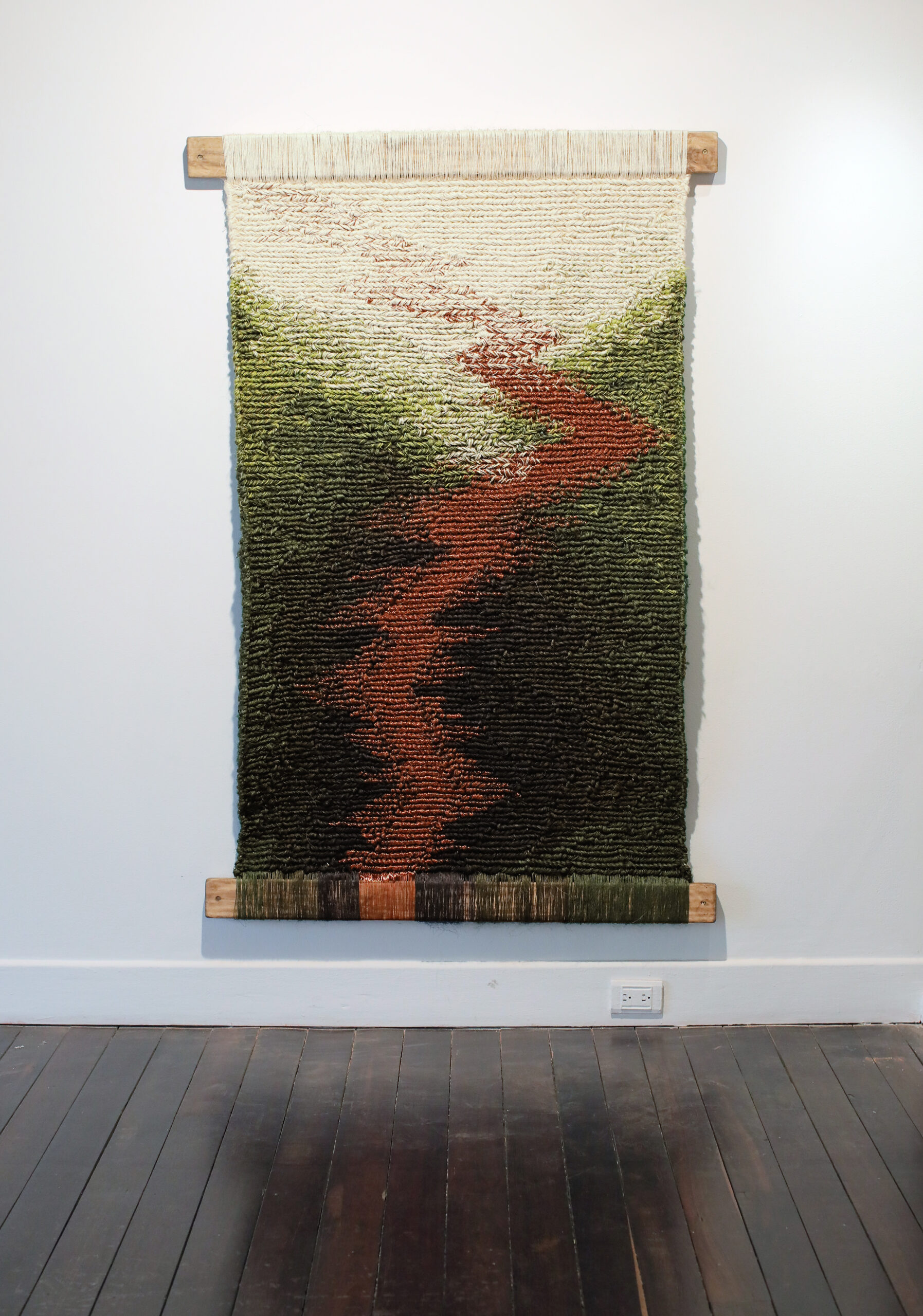
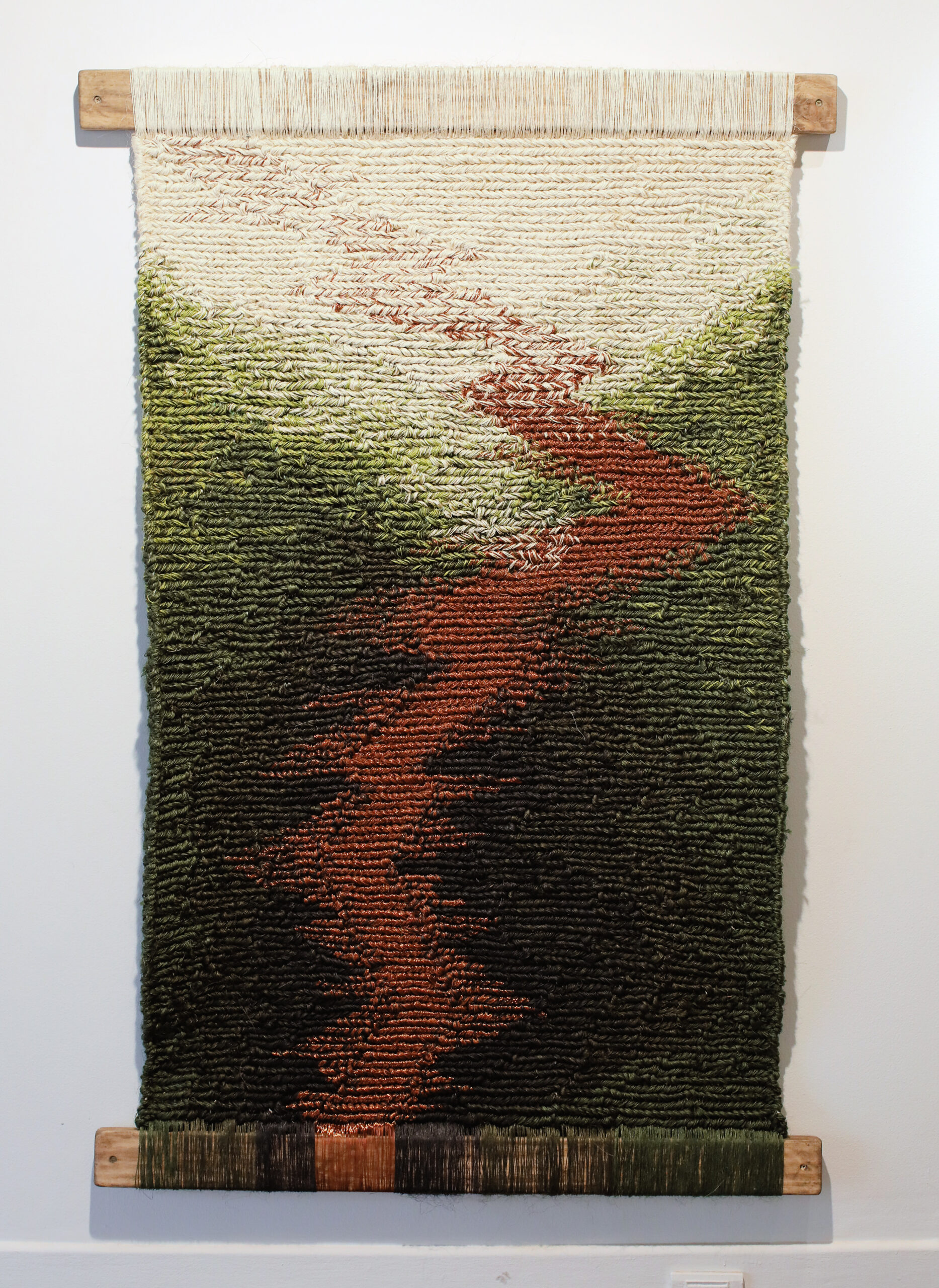
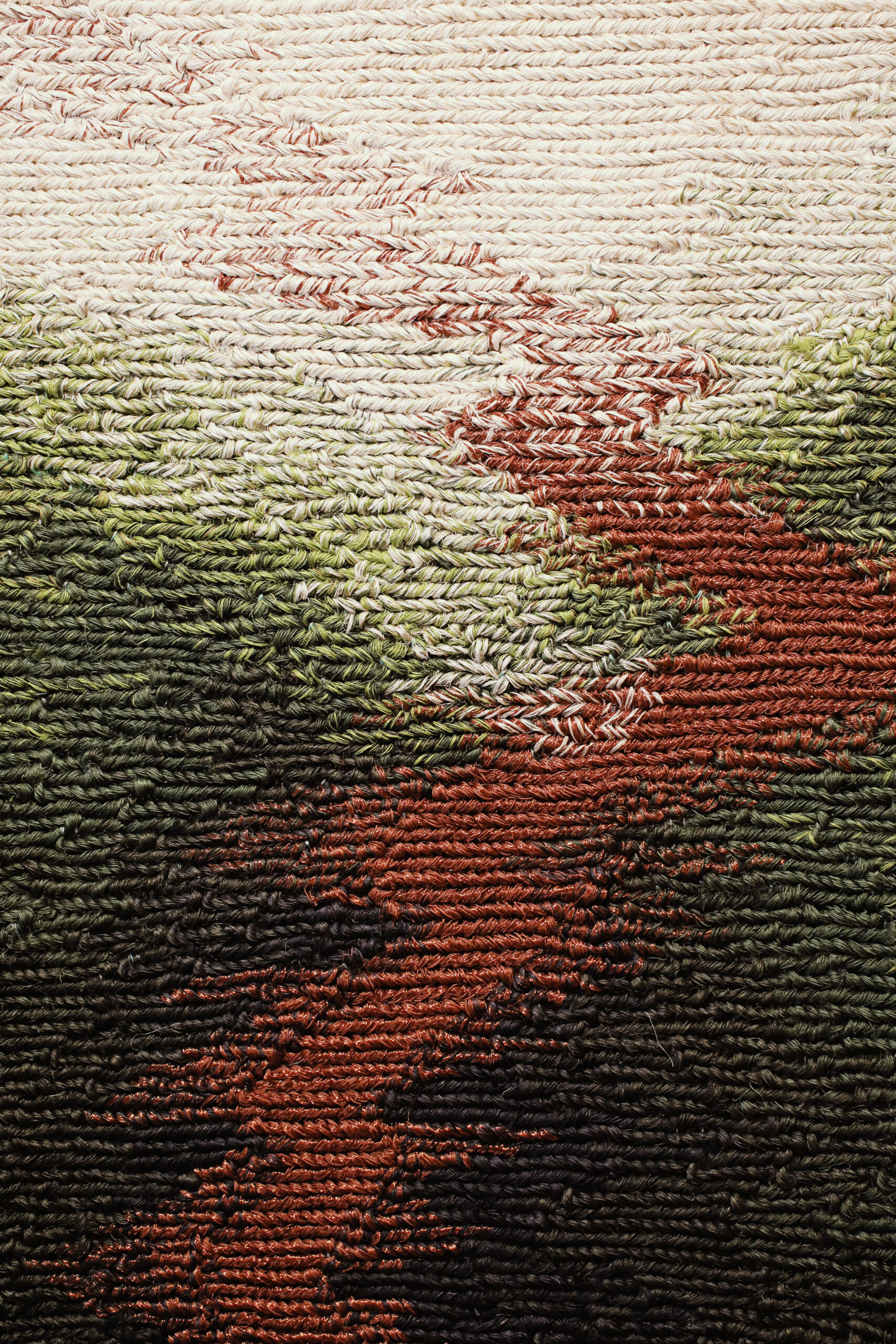
Ondas de la naturaleza, 2025. Dimensions: 160 x 100 x 5 cm. Vertical weaving with fique, copper wire, and metallic thread, supported by two wooden sticks.
For the Mhuysqa Indigenous people, energy circulates through the territory via water—lagoons, rivers, seas, rain, mist, and so on. Lagoons are the wombs of Mother Earth; there, the seeds of the sun and the water—masculine and feminine—unite, to later be carried by the rivers to the land where life is generated.
In the work Ondas de la Naturaleza, the artist weaves with fique, copper thread, and metallic thread the shape of a river seen from above—from a top-down perspective. For her, it is fascinating to realize that rivers, in their course, form figures similar to sound waves, understanding that the wave relates to the shape of the spiral and the vortex—forms associated with the origin of the cosmos. The river and the mist are woven with shimmering threads—copper and metallic thread—in order to emphasize water as a carrier of energy.
___
Para el pueblo indígena Mhuysqa, la energía circula por el territorio a través del agua: lagunas, ríos, mares, lluvia, niebla, etc. Las lagunas son el útero de la Madre Tierra; allí, las semillas del sol y del agua —masculino y femenino— se unen, para luego ser transportadas por los ríos a la tierra donde se genera la vida.
En la obra Ondas de la Naturaleza, la artista teje con fique, hilo de cobre e hilo metálico la forma de un río visto desde arriba, desde una perspectiva cenital. Para ella, es fascinante darse cuenta de que los ríos, en su curso, forman figuras similares a las ondas sonoras, entendiendo que la onda se relaciona con la forma de la espiral y el vórtice, formas asociadas con el origen del cosmos. El río y la niebla están tejidos con hilos brillantes —hilo de cobre y hilo metálico— para enfatizar el agua como portadora de energía.