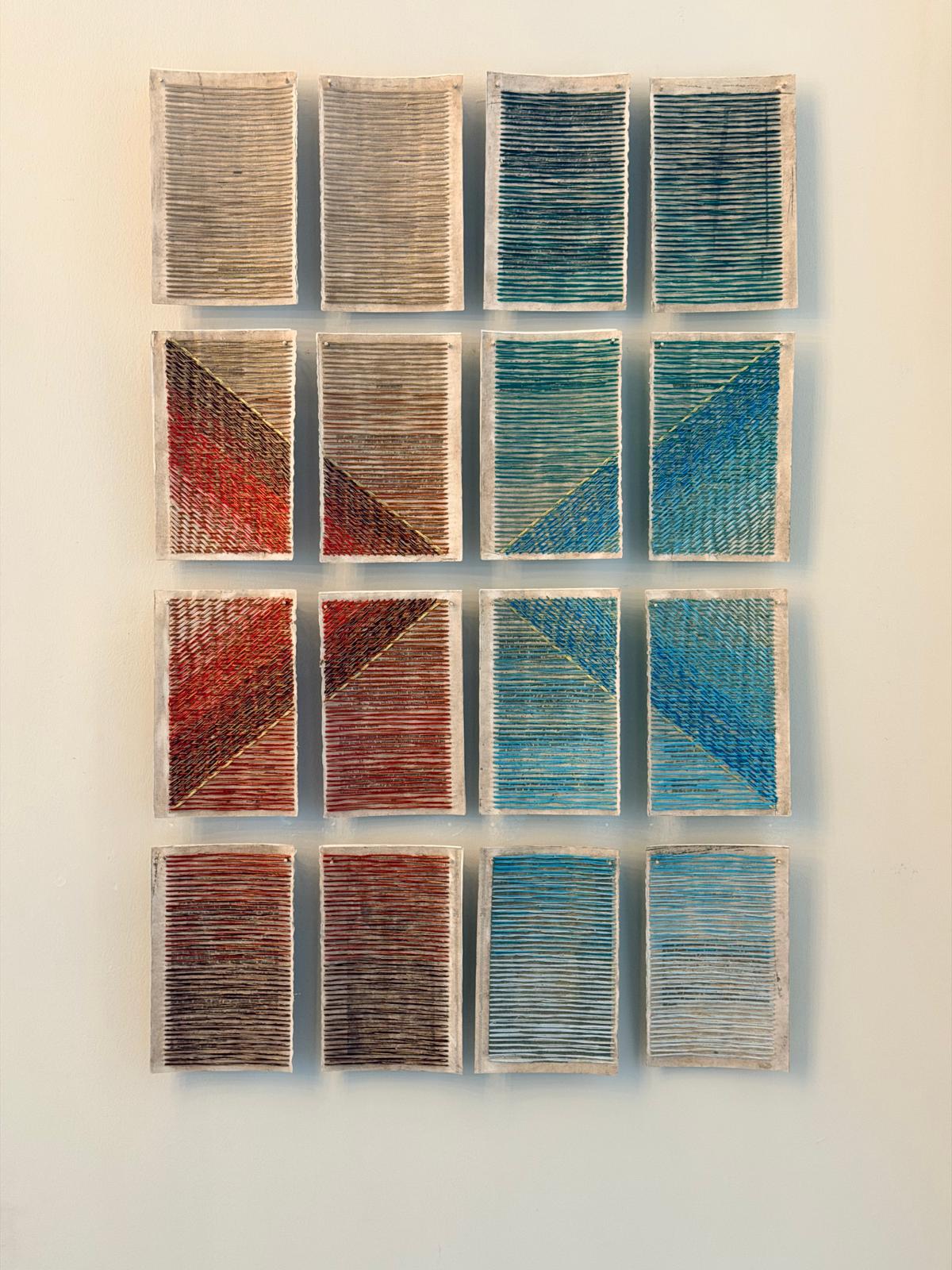
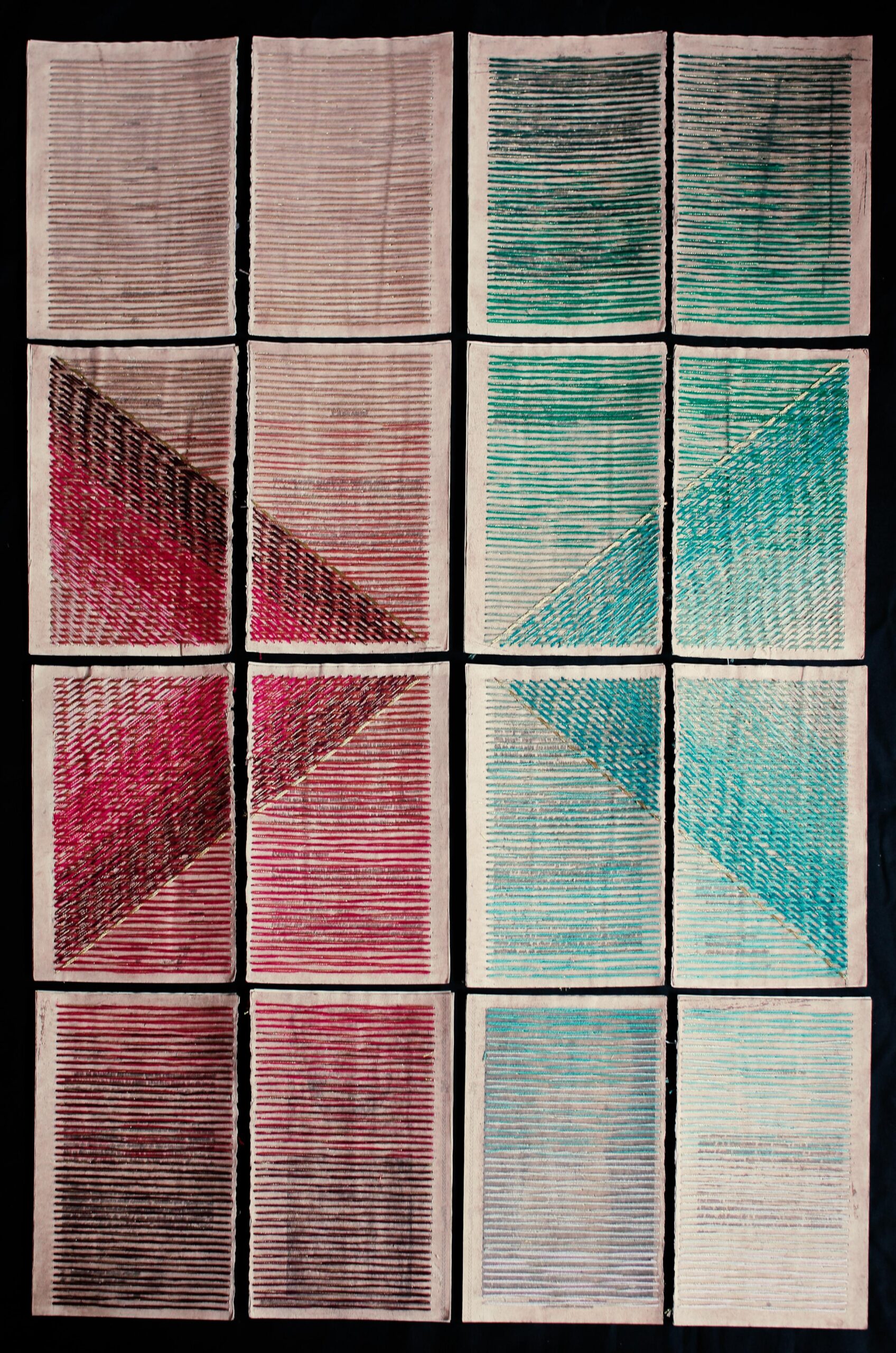

Principio de la polaridad. Embroidery with cotton threads on intervened book pages. Dimensions: 95 × 62 × 10 cm.
Hermetic philosophy is a philosophical–spiritual doctrine based on the writings attributed to the mythological figure Hermes Trismegistus. This philosophy centers on the knowledge of alchemy, astrology, and other sciences, and proposes the union of the human being with the divine. Hermes Trismegistus, known as “the thrice-great,” is considered the author of the Hermetic texts and the god of wisdom, existence, and life.
Within Hermetic philosophy we find the seven principles of The Kybalion, among which is the Principle of Polarity. This principle states that everything is dual: everything has poles and its opposite pair. Although we often perceive these poles as separate and completely different realities, they are in fact the extreme points of the same thing; in other words, they are part of a single being. For example, cold and heat, though opposite, are both manifestations of temperature.
The artwork titled Principle of Polarity is inspired by this law of The Kybalion: two triangles that at first appear to be opposites are, in fact, parts of the same geometric figure—the rhombus. It is enough to shift their position, to change our perspective, to recognize it. The same occurs with two colors situated at opposite ends of the chromatic spectrum: reds belonging to the warm colors and blues belonging to the cool colors are, ultimately, still colors.
These figures were embroidered onto book pages that were intervened by the artist: pages whose printed letters were torn and painted with earth, a material that, according to ancestral Andean cosmogonies, holds the memory and knowledge of the world. In this way, the artist questions history and learned knowledge, which were mostly written by those in power and shaped by their interests.
__
La filosofía hermética es una doctrina filosófico-espiritual basada en los escritos atribuidos a la figura mitológica de Hermes Trismegisto. Esta filosofía se centra en conocimientos de alquimia, astrología y otras ciencias, y propone la unión del ser humano con lo divino. Hermes Trismegisto, conocido como “el tres veces grande”, es considerado el autor de los textos herméticos y dios de la sabiduría, la existencia y la vida.
Dentro de la filosofía hermética encontramos los siete principios del Kybalion, entre ellos el principio de la polaridad. Este principio afirma que todo es dual: todo tiene polos y su par opuesto. Aunque solemos percibir estos polos como realidades separadas y totalmente diferentes, en realidad son extremos de una misma cosa; es decir, forman parte de un solo ser. Por ejemplo, el frío y el calor, aunque opuestos, son ambos manifestaciones de la temperatura.
La obra titulada Principio de la polaridad está inspirada en esta ley del Kybalion: dos triángulos que a primera vista parecen contrarios son, en realidad, partes de una misma figura geométrica —el rombo—. Basta con cambiar su posición, con desplazar nuestra mirada, para reconocerlo. Lo mismo ocurre con dos colores ubicados en extremos opuestos del espectro cromático: los rojos pertenecientes a los colores cálidos y los azules propios de los colores fríos siguen siendo, finalmente, colores.
Estas figuras fueron bordadas sobre páginas de libros intervenidas por la artista: páginas cuyas letras fueron rasgadas y pintadas con tierra, un material que, según las cosmogonías ancestrales de los Andes, posee la memoria y el conocimiento del mundo. De este modo, la artista cuestiona la historia y el conocimiento aprendidos, escritos en su mayoría por el poder y sus intereses.